
Tirzepatide is a dual GIP and GLP-1 receptor agonist developed by Eli Lilly. It is currently the most effective anti-obesity medication on the market (achieving 22.5% weight loss in a 72-week clinical trial). Survodutide is a dual GCG and GLP-1 receptor agonist developed by Boehringer Ingelheim, which achieved nearly 19% weight loss in a 46-week clinical trial.
Metabolic dysfunction-associated steatohepatitis (MASH) is a progressive liver disease associated with liver-related complications and death.
Compared with GLP-1 receptor agonists such as semaglutide, dual agonists may be more effective in treating metabolic dysfunction-associated steatohepatitis (MASH), but their efficacy and safety in patients with MASH and liver fibrosis remain unclear.
Recently, the New England Journal of Medicine (NEJM), a top-tier international medical journal, published two clinical trial results simultaneously, both evaluating GLP-1-class drugs in patients with metabolic dysfunction-associated steatohepatitis (MASH) and liver fibrosis.
Study 1: Tirzepatide for MASH with Liver Fibrosis
The first study is titled: Tirzepatide for Metabolic Dysfunction–Associated Steatohepatitis with Liver Fibrosis. This was a Phase 2, dose-finding, multicenter, double-blind, randomized, placebo-controlled clinical trial that enrolled 190 patients with biopsy-confirmed MASH and liver fibrosis stage F2 or F3 (moderate or severe). All participants were randomly assigned to 4 groups, receiving once-weekly subcutaneous tirzepatide treatment (5 mg, 10 mg, 15 mg, or placebo) for 52 weeks. The primary endpoint was MASH resolution without worsening of fibrosis at 52 weeks. Key secondary endpoints included improvement in fibrosis by at least 1 stage without worsening of MASH.
Results showed that the proportions of participants meeting the criteria for MASH resolution without worsening of fibrosis in the placebo, 5 mg, 10 mg, and 15 mg groups were 10%, 44%, 56%, and 62%, respectively, while the proportions with improvement in fibrosis by at least 1 stage without worsening of MASH were 30%, 55%, 51%, and 51%, respectively. The most common adverse events in the tirzepatide treatment groups were gastrointestinal events, most of which were mild or moderate.
These data indicate that in this Phase 2 clinical trial involving patients with moderate or severe fibrosis and MASH, tirzepatide treatment for 52 weeks was more effective than placebo with respect to MASH resolution without worsening of fibrosis. This result supports conducting larger, longer-term clinical trials to further evaluate the efficacy and safety of tirzepatide in treating MASH.
Study 2: Survodutide for MASH with Liver Fibrosis
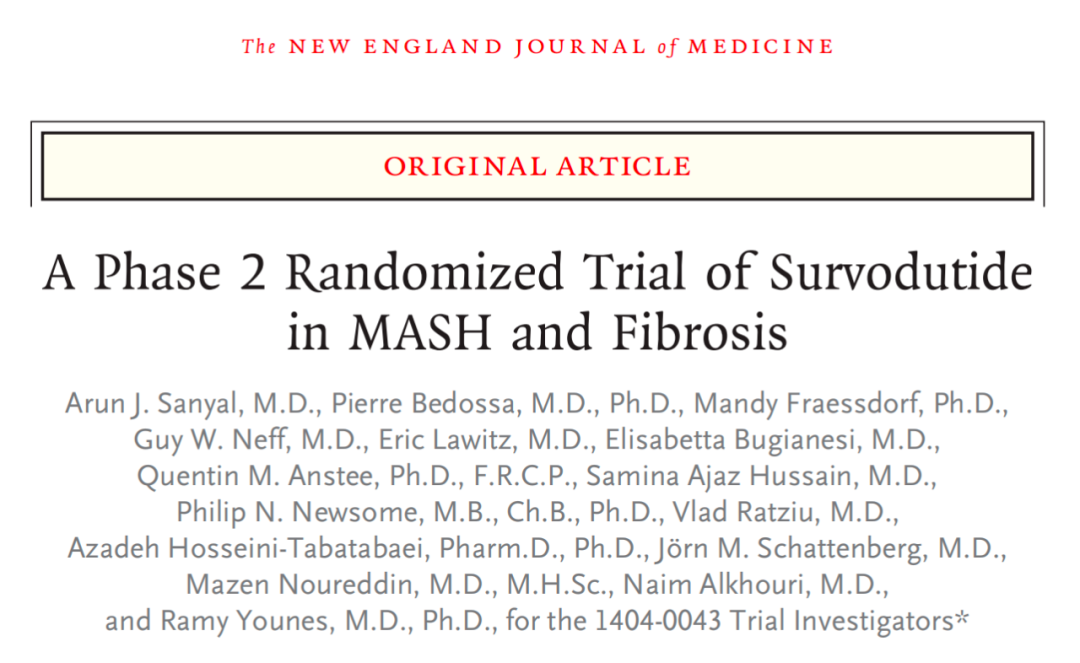
The second study is titled: A Phase 2 Randomized Trial of Survodutide in MASH and Fibrosis. This 48-week Phase 2 clinical trial randomly assigned 293 adult patients with biopsy-confirmed MASH and fibrosis stage F1–F3 in a 1:1:1:1 ratio to receive once-weekly subcutaneous survodutide treatment (2.4 mg, 4.8 mg, 6.0 mg, or placebo) for 48 weeks. The trial had two phases: a 24-week rapid dose-escalation phase, followed by a 24-week maintenance phase. The primary endpoint was histological improvement in MASH without worsening of fibrosis. Secondary endpoints included reduction in liver fat content by at least 30% and improvement in biopsy-assessed fibrosis by at least 1 stage.
Results showed that the proportions of participants with MASH improvement without worsening of fibrosis in the placebo, 2.4 mg, 4.8 mg, and 6.0 mg groups were 14%, 47%, 62%, and 43%, respectively; the proportions with reduction in liver fat content by at least 30% were 14%, 63%, 67%, and 57%, respectively; and the proportions with improvement in fibrosis by at least 1 stage were 22%, 34%, 36%, and 34%, respectively. The incidence rates of adverse events in the survodutide treatment groups and placebo group were nausea (66% vs. 23%), diarrhea (49% vs. 23%), and vomiting (41% vs. 4%). The incidence rates of serious adverse events in the survodutide treatment groups and placebo group were 8% and 7%, respectively.
Overall, survodutide was superior to placebo in improving MASH without worsening of fibrosis, warranting further investigation in larger Phase 3 clinical trials.
Summary and Outlook
Two Phase 2 clinical trials published simultaneously in NEJM demonstrate that tirzepatide and survodutide, two dual agonists, both showed efficacy superior to placebo in patients with MASH and liver fibrosis, particularly on the key endpoint of MASH resolution without worsening of fibrosis. Tirzepatide achieved MASH resolution rates of up to 62% at 52 weeks, and survodutide up to 62% at 48 weeks. These results support conducting larger, longer-term Phase 3 clinical trials to further evaluate the efficacy and safety of dual agonists in treating MASH, bringing new therapeutic hope to patients with MASH.