
Why Are Peptide Drugs Booming? A New Direction in Targeted Therapy from Metabolic Disease to Cancer
Overview
Evidence suggests (Xiao et al., Nature) that pharmaceutical companies are investing heavily in peptide drugs. They have begun combining these short sequences with other chemical payloads.
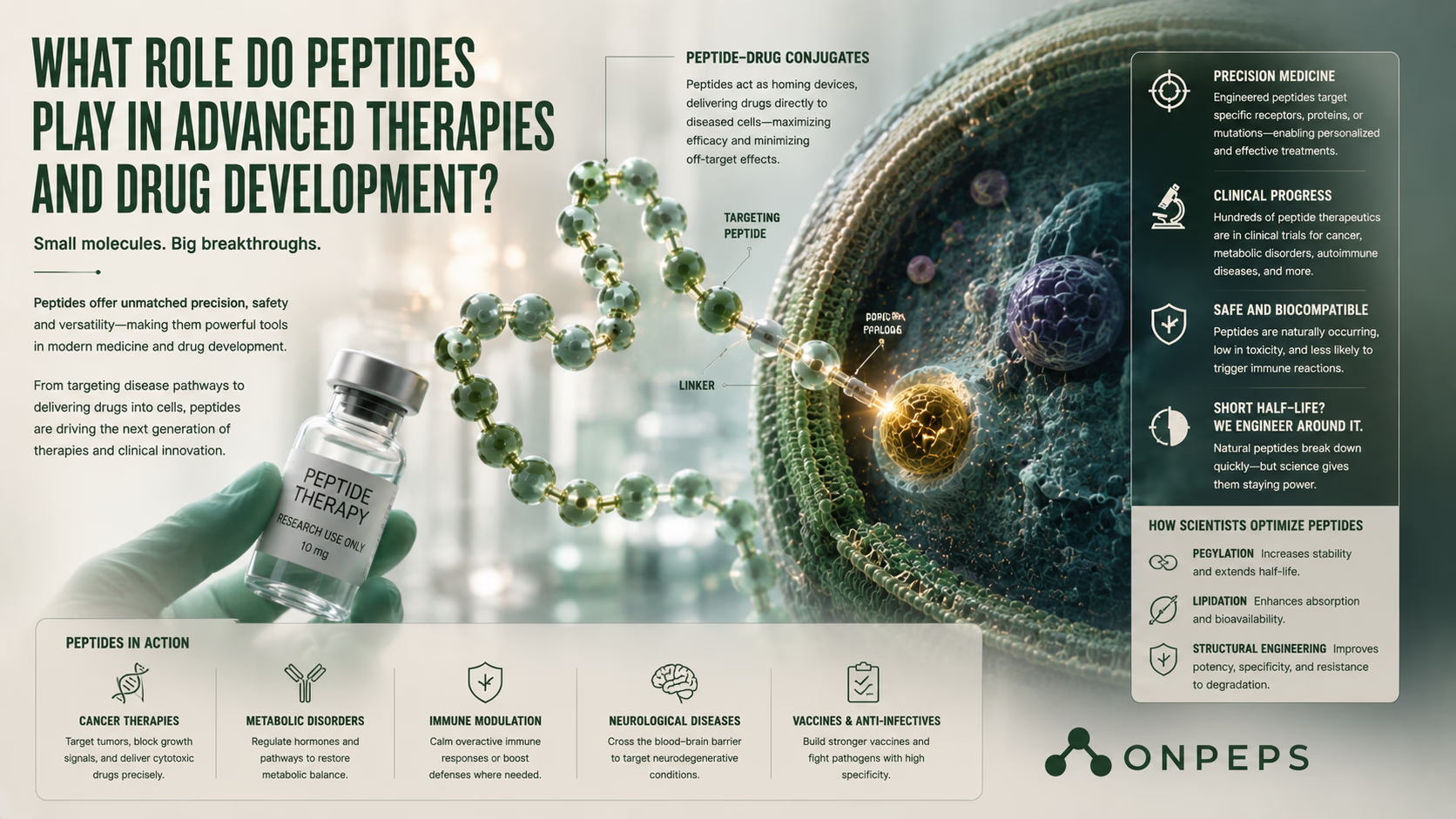
These combinations build highly targeted delivery systems known as conjugates. These conjugates can deliver drugs directly to diseased cells, avoiding collateral damage to healthy tissue.
This article explains why peptide drugs have become an important direction in modern drug development, along with the key challenges they face and the strategies used to address them.
1. Why Pharmaceutical Companies Favor Peptide Drugs
The clinical trial pipeline is already enormous. Hundreds of new drugs are currently in Phase I, II, and III clinical trials, targeting a wide range of serious human diseases.
Major research areas include metabolic diseases, cardiovascular diseases, and cancer.
The core reason peptide drugs are favored lies in their targeting ability. Peptides can bind to specific receptors, and this specificity makes them more precise than many traditional small-molecule drugs, while also penetrating tissues more easily than large protein molecules.
This intermediate property — between small molecules and proteins — makes peptide drugs a unique and important category in modern drug development.
2. Conjugates: Highly Targeted Delivery Systems
An important direction in peptide drugs is the conjugate. Researchers combine peptides with other chemical payloads to build highly targeted delivery systems.
These conjugates can deliver drugs directly to diseased cells, avoiding collateral damage to healthy tissue. For example, this targeted therapeutic approach is revolutionizing cancer treatment.
The core idea of a conjugate is this: use the peptide as a "navigation system" to bring the drug precisely to the target cell, rather than letting it distribute randomly throughout the body. This strategy improves efficacy while reducing side effects.
3. The Half-Life Problem: PEGylation and Lipidation
Researchers are working to extend how long these drugs remain active in the body. A key concept is the peptide half-life, which refers to the time required for the drug to be broken down or cleared from the body by half.
So how do scientists extend the half-life of peptides? Mainly through techniques such as PEGylation and lipidation.
PEG stands for polyethylene glycol. It is a synthetic water-soluble compound made up of repeating ethylene glycol units. Simply put, it is a long, flexible molecule that dissolves easily in water. In medicine, PEG is used to improve drug stability and extend how long a drug stays in the body.
PEGylation refers to attaching a polyethylene glycol (PEG) chain to a peptide. This additional chain increases the molecule's size and protects it from enzymes that would normally break it down. It also slows the body's clearance of the peptide from the blood.
Lipidation refers to attaching a lipid (fat molecule) to a peptide. This helps the peptide bind to proteins in the blood, such as albumin. Because of this binding, the peptide stays in the bloodstream longer and is released more slowly over time.
These modifications help prevent the drug from breaking down too quickly. As a result, the drug stays in the blood longer, reducing the number of injections required.
4. Cell-Penetrating Peptides: How to Get Drugs into Cells
Delivering drugs into cells is a major biological challenge. The cell membrane acts as a protective barrier, preventing most substances from entering. However, certain short sequences are able to cross this barrier — these are known as cell-penetrating peptides.
They typically consist of fewer than 30 amino acids and are rich in basic amino acids such as arginine and lysine. Arginine is a positively charged amino acid that helps peptides enter cells. Lysine is also a positively charged amino acid that helps peptides attach to the cell surface and enter the cell interior. This chemical composition allows them to interact with the cell membrane and enter cells without causing permanent damage.
The mechanism by which cell-penetrating peptides enter cells is not a single one. Research consistently shows two main pathways:
Endocytosis is the most common mechanism. In this process, the cell membrane wraps around the peptide, forms a vesicle, and pulls it into the cell. This is the energy-dependent pathway used by most cell-penetrating peptides (Lee et al., Nature).
Endocytosis has multiple subtypes, including macropinocytosis, clathrin-mediated uptake, and caveolae-mediated pathways. All of these fall under the category of endocytosis.
Direct translocation is rarer and more controversial. In this pathway, the peptide crosses the cell membrane directly without vesicle formation or classic uptake mechanisms. It occurs through interactions with the lipid membrane and is considered an energy-independent mode of entry (Hernandez & Marin, Springer).
Proposed mechanisms include transient pore formation, membrane destabilization, and inverted micelle structures (Trabulo et al., National Institutes of Health).
These two mechanisms can occur simultaneously in the same system. The same peptide can switch between different pathways depending on concentration, cargo, and cell type (Ruseska and Zimmer, National Institutes of Health).
5. Summary
Peptide drugs have become an important direction in modern drug development for four main reasons:
First, strong targeting. Peptides can bind to specific receptors, making them more precise than many small-molecule drugs.
Second, advanced delivery systems. Conjugates can deliver drugs directly to diseased cells, reducing damage to healthy tissue.
Third, the half-life problem has solutions. PEGylation and lipidation can extend how long a drug stays in the body, reducing the number of injections.
Fourth, clear cell-entry mechanisms. Cell-penetrating peptides can enter cells through endocytosis or direct translocation, opening possibilities for intracellular drug delivery.
Together, these factors are driving the broad application of peptide drugs from metabolic disease to cancer, and making them one of the core directions of next-generation targeted therapy.
Frequently Asked Questions
What is the difference between peptide drugs and biologics?
Peptide drugs are usually produced through chemical synthesis, while biologics are produced by biological systems. Their manufacturing methods and regulatory pathways differ.
Why is peptide drug development so expensive?
They require complex synthesis, purification, and strict regulatory testing. Each step demands high precision, which drives up the cost.
What is the half-life of a peptide?
It refers to the time required for the drug to be broken down or cleared from the body by half. The longer the half-life, the longer the drug stays in the body and the less frequent the injections.
Why can cell-penetrating peptides enter cells?
They are typically rich in positively charged basic amino acids, which allow them to interact with the cell membrane and enter cells through endocytosis or direct translocation.